


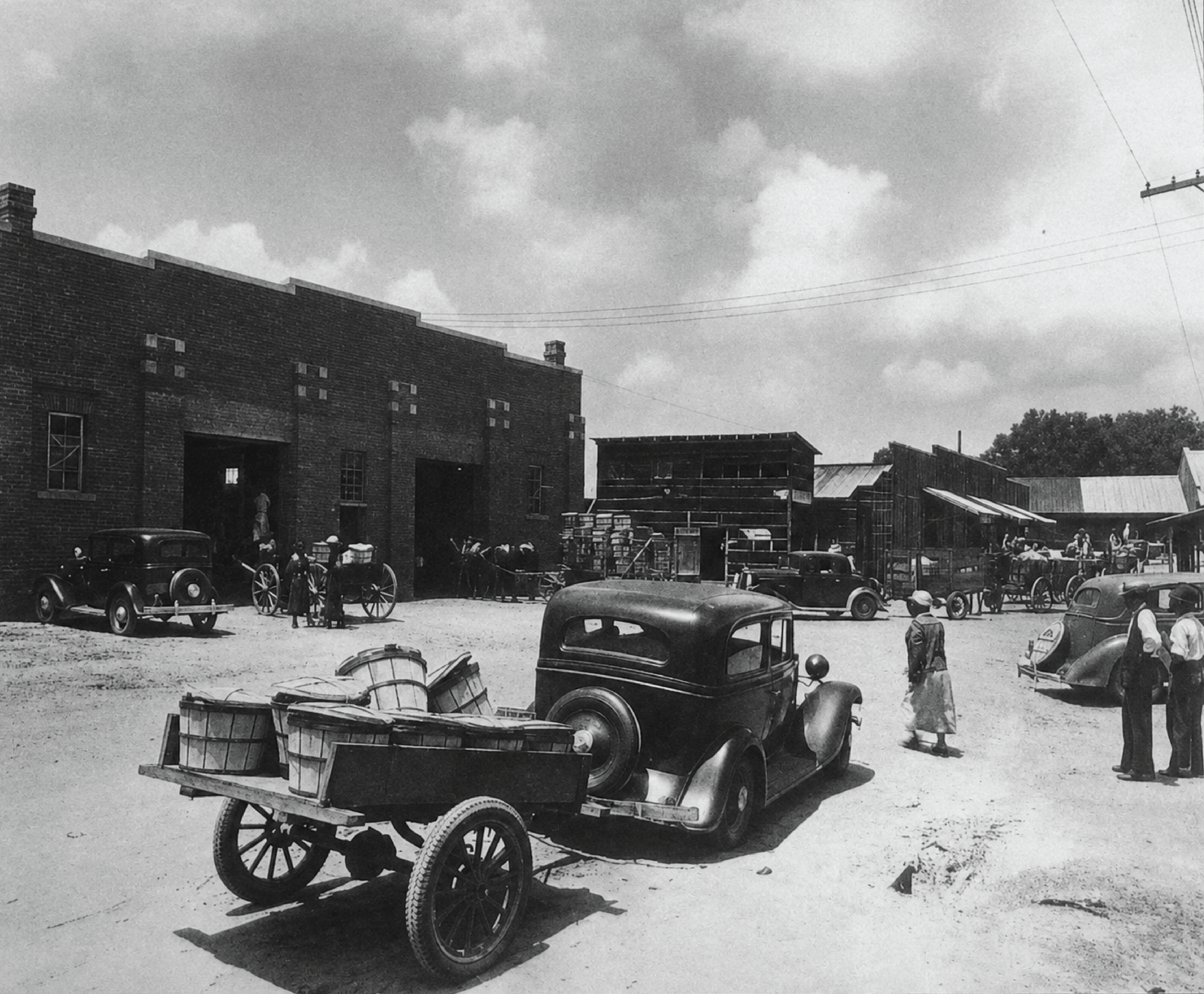
Built in 1936 by the Public Works Administration (PWA) as part of Franklin Delano Roosevelt’s New Deal, the Lake City Bean Market became nationally recognized as the world’s largest truck auction for green beans during Lake City’s agricultural prime. Farmers traveled from communities throughout the South to bring their crops to the centrally located market, where buyers purchased the produce and shipped it north by the many freight trains passing through Lake City each day. During the Great Depression, the Bean Market provided much-needed economic stability to the community, with farmers lining up for miles in hopes of a profitable day. For nearly three decades, the market established Lake City as an important center of agricultural commerce in South Carolina. In 1956, the City of Lake City transferred market management to the Produce Marketing Association of Lake City, a group of local farmers and buyers. By the late 1960s, however, the market closed because it lost original buyers and supporters, faced competition from produce auctions in other communities, and saw tobacco's growing dominance as a cash crop. As tobacco became Lake City’s primary agricultural commodity, farmers increasingly viewed produce such as beans and cucumbers as a filler crop.
After the market closed, the City of Lake City used the building for storage from the late 1960s through the 1990s, modifying the structure to suit its new purpose. In 1999, the Community Museum Society, Inc. purchased the building and established the National Bean Market Museum of South Carolina, creating a lasting opportunity to preserve the community’s agricultural history and celebrate its heritage. Known locally as “The Bean Market,” the historic building has been fully restored and now serves as a multipurpose cultural and community center and event venue in the heart of downtown Lake City. Today, the Bean Market stands as a testament to the community’s agricultural roots, the resilience of its people, and the important role Lake City once played in South Carolina’s produce industry.


